
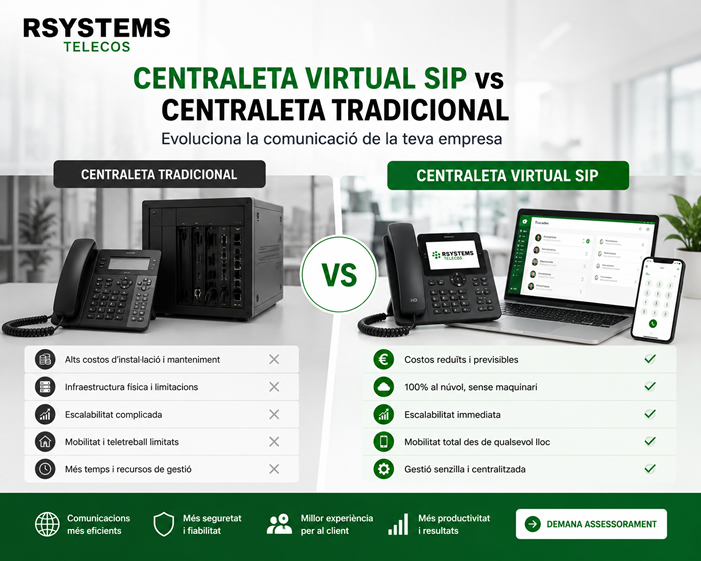
SIP virtual phone system vs traditional phone system: differences and advantages
For many years, companies have worked with traditional phone systems installed physically in their offices. These systems have been useful for a long time, but the way companies operate has changed: today there is more mobility, more locations, more remote work, more digital tools and a greater need for flexibility.
That is why more and more businesses are considering replacing or modernising their telephone systems with a SIP virtual phone system. The difference is not only technical: it directly affects how the company receives calls, organises extensions, manages queues, applies schedules, works outside the office and provides customer service.
In this article, we compare a SIP virtual phone system with a traditional phone system so you can understand when it makes sense to make the change and what advantages it can bring to a company.
What is a traditional phone system?
A traditional phone system is a physical telephone system installed at the company’s premises. It usually depends on local equipment, telephone lines, handsets and a configuration linked to that specific installation.
This type of phone system can provide internal extensions, call forwarding and some basic features, but it is usually less flexible when the company needs to grow, change schedules, add users or connect people who work outside the office.
What is a SIP virtual phone system?
A SIP virtual phone system is an IP telephony solution that works through the internet and allows companies to manage communications without depending on a traditional physical phone system installed at the premises.
With a SIP virtual phone system, companies can configure extensions, call queues, greetings, IVR menus, schedules, call forwarding, voicemail, IP phones, softphones and mobile applications. All of this provides much greater flexibility and allows the system to adapt to the company’s real day-to-day needs.
Main difference: flexibility
The most important difference between a traditional phone system and a SIP virtual phone system is flexibility. A traditional system is usually closely linked to a physical installation. A virtual phone system, on the other hand, can adapt much better to changes in teams, schedules, locations and business needs.
Adding extensions
With a SIP virtual phone system, it is easier to add new extensions for employees, departments or locations. If the company grows, the telephone system can grow with it without having to redesign the entire installation.
Changing schedules
Opening hours, out-of-hours messages and call forwarding can be adjusted according to the company’s real activity. This is useful during holidays, special periods, shifts or temporary changes.
Working outside the office
With a virtual phone system, users can answer calls from an IP phone, a computer or a mobile application. This makes remote work, sales mobility and service continuity easier.
Costs and maintenance
A traditional phone system may involve physical equipment, local maintenance, expansion limitations and dependence on a specific installation. A SIP virtual phone system, on the other hand, usually reduces the need for in-house hardware and enables more scalable management.
This does not mean it is always cheaper in every situation, but it can offer a much more attractive balance between features, flexibility and cost for many companies.
Less physical equipment
A virtual phone system reduces dependence on physical equipment installed at the company. IP phones, softphones and an internet connection are the main elements required to operate.
Faster changes
Changing a queue, greeting, schedule or forwarding rule can be much faster than with a traditional phone system.
Scalability
A virtual phone system allows the configuration to be expanded or reduced according to the company’s actual needs. This is especially useful for businesses that are growing, changing structure or have variable teams.
Advanced features
SIP virtual phone systems provide many features that help companies professionalise their telephone communications.
- Internal extensions for users or departments.
- Call queues.
- Welcome greetings.
- IVR menus.
- Business hours and out-of-hours messages.
- Call forwarding to mobile phones or other extensions.
- Voicemail.
- Softphone applications for computers or mobile devices.
- Multi-site telephony.
- Call reports and monitoring options.
Some traditional phone systems can also offer part of these features, but often with less flexibility or greater configuration complexity.
Mobility and remote work
This is one of the areas where a SIP virtual phone system has the greatest advantage. Today, many companies have sales teams, technicians, managers or administrative staff who may need to work outside the office.
With a traditional phone system, telephone services are usually closely tied to a physical location. With a SIP virtual phone system, users can remain connected to the company’s telephone system even when working from another location.
Softphone
A softphone allows users to use their computer or mobile device as the company’s telephone terminal. This is very useful for sales teams, remote work or support services.
Mobile apps
Mobile applications allow users to make and receive professional calls without depending only on the office desk phone.
Multi-site operation
If a company has several offices or branches, a virtual phone system allows them to be connected within the same telephone structure.
Professional image for customers
A well-configured phone system helps create a much more professional image. When a customer calls and hears a clear greeting, can choose a department, is placed in an organised queue or receives an out-of-hours message, the perception of the service improves.
Telephony is not only a technical issue. It is also part of the customer experience.
When is it worth keeping a traditional phone system?
There may be cases where a company does not need to make the change immediately. If the current phone system works well, there are few calls, mobility is not required, no changes are expected and the system covers the company’s needs, replacing it may not be urgent.
However, it is advisable to review whether the current system limits growth, creates unnecessary costs or prevents improvements to telephone service.
When should a company move to a SIP virtual phone system?
A company should consider a SIP virtual phone system when it identifies some of the following situations:
- The current phone system is old or difficult to modify.
- Calls are being missed or queues are not properly configured.
- New extensions or users need to be added.
- The company needs mobility or remote work capabilities.
- There are several locations or distributed teams.
- The company wants to improve its telephone image with greetings and IVR menus.
- The company wants to reduce dependence on physical equipment.
- More control is needed over schedules, forwarding and call management.
The importance of connectivity and network infrastructure
A SIP virtual phone system works over the internet, so connectivity and the internal network are important. The company should review the fiber connection, router, switches, cabling and WiFi if softphones or mobile devices are used.
A poor connection or incorrectly configured network can affect call quality. Therefore, it is advisable to consider IP telephony together with the company’s overall telecommunications infrastructure.
SIP virtual phone systems with RSystems Telecos
At RSystems Telecos, we help companies assess whether they should keep, renew or replace their current telephone system. We review the existing setup, call volume, extensions, schedules, queues, mobility requirements, connectivity and growth needs.
The goal is to implement a telephone solution that is clear, flexible and useful for the company’s real day-to-day operations.
You can find more information about this service on our page about SIP virtual phone systems for companies.
Would you like to compare your current phone system with a SIP solution?
If you have an old phone system, call problems, limited flexibility or you want to modernise your company’s telephony, we can help you review your current situation and propose an adapted alternative.
Contact RSystems Telecos and tell us how your company currently works.


