
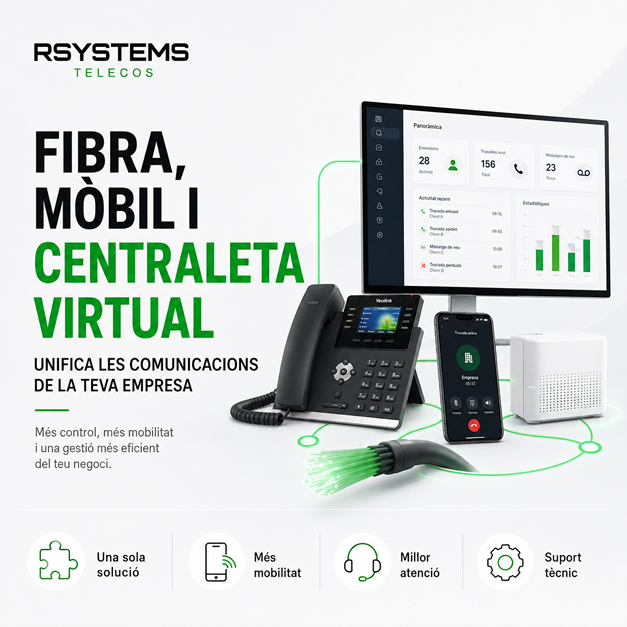
Fiber, mobile, and PBX: how to unify business communications
Many companies have their communications spread across different providers, contracts, and systems: fiber on one side, mobile lines on another, an outdated PBX, IP phones, manual call forwarding, and configurations that nobody fully controls.
This situation may work for a while, but when the company grows or needs more agility, problems begin to appear: duplicated management, incidents where nobody knows the cause, missed calls, limited mobility, and difficulty making changes.
Unifying fiber, mobile, and PBX for businesses allows companies to organize their communications, improve technical control, and make everything work as a single solution.
What does it mean to unify a company’s communications?
Unifying communications means treating fiber, mobile lines, IP telephony, virtual PBX, WiFi, and the network as parts of the same system, rather than separate services that operate independently.
This provides a clearer view of what the company needs, how calls should be distributed, which users require mobility, which services depend on the connection, and what infrastructure is needed to work reliably.
Why is it important not to contract everything separately?
When each service depends on a different provider or configuration, resolving an issue can become much more complicated. If telephony fails, the problem could be the PBX, the fiber connection, the router, the internal network, or even the WiFi.
If nobody has a global view of the system, it is easy for each part to point to another and for the company to lose time before finding the real source of the problem.
Less duplicated management
Having a single technical point of contact greatly simplifies management. The company does not have to move between providers to find out who should review an incident or apply a change.
Greater technical consistency
When fiber, PBX, mobile services, and the network are planned together, it is easier to avoid incompatibilities, improvised configurations, or solutions that do not work well together.
Better cost control
Unifying services also helps review what is being paid for, what is actually being used, and whether there are lines, services, or configurations that no longer provide value.
Professional fiber: the foundation of the entire system
Fiber is the foundation of many business communications. It is not only used for browsing the internet: it can also support IP telephony, virtual PBX systems, video calls, cloud applications, security systems, remote backups, and access to internal tools.
For this reason, a company should not simply contract any connection. It is necessary to review speed, stability, the need for a static IP, router, internal network, and the actual needs of the business.
An improperly sized connection can directly affect call quality, WiFi, cloud systems, and daily work.
Business mobile services: mobility and continuity
Mobile lines are an important part of communications for many companies. Sales teams, technicians, management, administration staff, or mobile employees may need to stay connected outside the office.
When mobile services are part of the communication strategy, it becomes easier to prepare call forwarding, service continuity, and a more flexible way of working.
Sales teams
Sales representatives may need to receive customer calls, contact opportunities, and work outside the office without losing the company’s telephone identity.
Technicians and mobile employees
Technicians or teams that travel may need to remain reachable, receive forwarded calls, or communicate smoothly with customers and the office.
Management and department leaders
In certain cases, managers or department heads may need to receive important calls even when they are not physically at the company.
Virtual SIP PBX: the center of telephony
The virtual SIP PBX allows companies to organize their telephone system with extensions, call queues, greetings, schedules, call forwarding, voicemail, softphones, and mobility.
When combined with reliable fiber and well-planned mobile lines, the PBX becomes the center of the company’s telephone communications.
Extensions for users and departments
Each person or department can have their own extension. This helps route calls, organize telephone support, and prevent everything from depending on a single phone.
Queues and greetings
Call queues and greetings allow companies to provide a more professional image and reduce missed calls during high call volumes.
Call forwarding and mobility
The PBX can forward calls to mobile phones, softphones, or other extensions depending on schedules, availability, or business needs.
What does a company gain by unifying fiber, mobile, and PBX?
Unifying these services can provide very practical day-to-day benefits.
- Less management with different providers.
- Better technical control of the complete solution.
- Easier resolution of incidents.
- More flexible and professional telephony.
- Better integration between office, mobile, and remote work.
- Ability to review costs and contracted services.
- Consistent configuration between fiber, network, PBX, and mobile services.
- Closer and more specialized technical support.
Practical examples of unification
Every company has different needs, but there are common scenarios where unifying communications makes a lot of sense.
An office with reception and sales teams
Fiber provides service to the office, the PBX manages incoming calls, queues distribute customer service, and sales teams can use mobile phones or softphones when they are away.
A company with multiple locations
Different offices can work with the same PBX structure, internal extensions, and coordinated communication, even when they are in different locations.
A business with mobile technicians
Calls can enter the PBX, go through a greeting or queue, and be forwarded to technicians or managers depending on availability.
A company with remote workers
People working from home can remain connected to corporate telephony through softphones, extensions, and configured call forwarding.
Common mistakes when communications are not unified
When infrastructure grows without planning, problems can appear that eventually affect the company.
- Calls that do not reach the correct department.
- Poorly configured manual call forwarding.
- Mobile lines that are not integrated with company telephony.
- Incidents where it is unclear whether the issue is with fiber, router, PBX, or network.
- Different providers without coordination.
- Duplicated costs or unused services.
- Difficulty expanding extensions, users, or locations.
The importance of technical support
In business telecommunications, technical support is essential. It is not enough to contract lines or activate services. They must be properly configured, tested, documented, and adaptable when the company needs changes.
Good technical support can review an incident globally: connection, router, network, WiFi, IP phones, PBX, mobile services, and configurations.
Unifying does not mean making things more complicated
Unifying services does not have to be more complicated. On the contrary: the goal is for the company to have a clearer, less fragmented, and easier-to-manage solution.
The key is to design a simple, consistent architecture adapted to real needs. Not all companies need the same thing, but all need communications that work reliably.
Fiber, mobile, and PBX with RSystems Telecos
At RSystems Telecos, we help companies unify professional fiber, business mobile services, IP telephony, and virtual SIP PBX systems. We review the current situation, contracted services, call volume, internal network, mobility, and growth needs.
The goal is for company communications to be simpler, more stable, and easier to manage.
You can find more information about business connectivity on our professional fiber for businesses page and about telephony on our virtual SIP PBX for businesses page.
Would you like to organize your company’s communications?
If you have fiber, mobile services, and telephony spread across different providers or want to review whether management can be simplified, we can help you evaluate a clearer and more suitable solution.
Contact RSystems Telecos and tell us how your communications are currently organized.


