
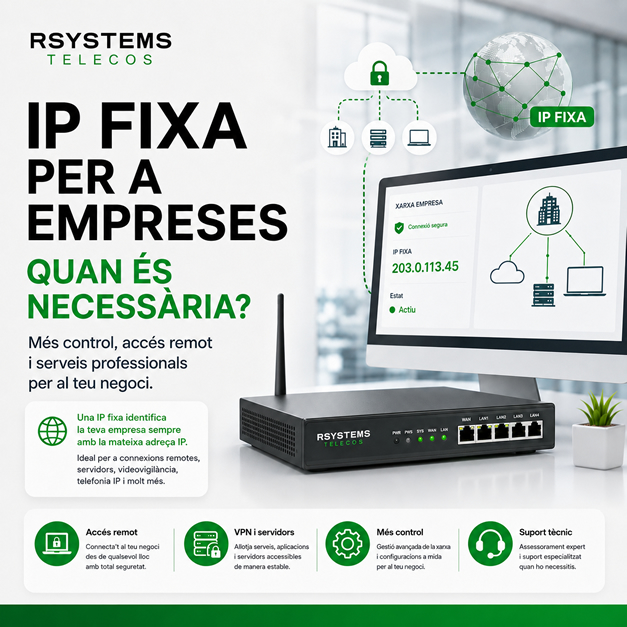
Static IP for businesses: when is it necessary and what is it used for
When a company contracts a fiber connection, it often focuses mainly on speed: 600 Mb, 1 Gb, symmetrical fiber, or packages with mobile services. However, there is another element that can be very important depending on the type of business: the static IP for businesses.
Not all companies need a static IP, but in many cases it may be recommended or even directly necessary. Especially when there is remote access, VPN, IP cameras, servers, SIP PBX, internal systems, or services that must always be reachable from outside.
In this article, we explain what a static IP is, how it differs from a dynamic IP, and when it makes sense to contract one in a professional environment.
What is a static IP?
An IP is the address that identifies an internet connection. In a simplified way, it is like a digital address that allows a network or device to be located within the internet.
When we talk about a static IP, we mean an IP address that does not change. In other words, the company always keeps the same public address to identify its connection.
On the other hand, with a dynamic IP, the provider may assign a different address over time. For home use or very basic usage, this may not matter, but in business environments it can become a problem if there are services that depend on a stable address.
Difference between static IP and dynamic IP
The main difference is the stability of the address. With a dynamic IP, the public address may change. With a static IP, the company knows it will always have the same identifiable address.
Dynamic IP
It is the most common option for many standard connections. It can be sufficient for browsing, using email, working with cloud applications, making video calls, or accessing web services.
However, it may not be enough when the company needs to publish, access, or control internal services in a stable way.
Static IP
It is more suitable when a permanent address is required to access devices, configure services, allow remote connections, or identify the company network consistently.
This can be very useful for companies with technical systems, more advanced networks, cameras, servers, or PBX systems.
When does a company need a static IP?
A company may need a static IP in different situations. It is not always essential, but it is highly recommended when the connection is part of a professional infrastructure.
Remote access to the company
If access from outside to internal company resources is required, a static IP can greatly simplify configuration. For example, access to servers, internal applications, remote desktops, or specific devices.
Having a fixed address avoids having to rely on IP changes or less stable solutions.
VPN for remote work
VPNs allow authorized users to securely connect to the company network from outside. In these cases, a static IP makes it easier for the connection point to always remain the same.
This is especially useful for management, administration, technicians, sales teams, or people who need to access internal resources while working away from the office.
IP cameras and video surveillance
In IP video surveillance installations, a static IP can help better manage remote access, recorder configuration, control systems, and monitoring platforms.
Although there are cloud-based alternatives or systems with access through applications, in many professional environments a static IP provides greater control and stability.
SIP PBX and IP telephony
In some virtual SIP PBX or IP telephony scenarios, a static IP can facilitate more secure and controlled configurations. It can also help define rules, permissions, access, or communications with telephony providers.
It is not always mandatory, but it can be interesting when telephony is critical for the business.
Internal servers or proprietary applications
Some companies have internal servers, management applications, time tracking systems, ERP, production tools, or services that need to be accessible from outside.
In these cases, a static IP can simplify configuration and help maintain more stable access.
Access control and automation systems
Companies with connected doors, relays, automation systems, alarms, or control systems may also need a stable configuration to access or manage devices remotely.
A static IP can be part of a broader security and connectivity strategy.
Does a static IP improve internet speed?
Not necessarily. A static IP does not make the connection faster by itself. Speed depends on the contracted fiber service, connection quality, router, internal network, and other factors.
A static IP is not a speed improvement, but rather an improvement in identification, stability, and configuration for professional services.
Is a static IP always necessary?
No. Many companies can work perfectly well without a static IP if they only use cloud services, email, web browsing, video calls, and external applications that do not require incoming access to the network.
However, when there are internal services, remote access, cameras, VPNs, PBX systems, or devices that need to be managed from outside, it is highly recommended to consider one.
Static IP and security
Having a static IP also involves responsibility. If a company exposes services to the internet, it must do so securely. Having a stable address is not enough: the router, firewall, passwords, permissions, and access controls must be properly configured.
Poor configuration can create risks. Therefore, when working with a static IP, it is important that the infrastructure is properly protected.
Do not open ports without proper consideration
Opening router ports without knowing exactly what is being done can be dangerous. It is necessary to review which services are exposed and whether it is really required.
Use VPN whenever possible
Whenever possible, it is better to use secure VPN connections instead of exposing services directly to the internet.
Control permissions and users
Remote access should be limited to people who actually need it and protected with strong credentials.
Static IP, fiber, and internal network
A static IP is only one part of the infrastructure. For everything to work properly, it is also necessary to review the fiber connection, router, internal network, cabling, switches, WiFi, and connected devices.
A company can have a static IP and still experience problems if the router is not suitable, if the network is overloaded, or if the WiFi is not properly sized.
That is why it is important to consider business connectivity as a complete solution, not just as a simple internet line.
Common mistakes with static IPs in businesses
Some common mistakes are:
- Contracting a static IP without knowing exactly why it is needed.
- Failing to properly protect exposed services.
- Opening ports without technical criteria.
- Not documenting router, firewall, or VPN configurations.
- Not checking whether the internal network is prepared.
- Using weak passwords for remote access.
- Not having technical support when configuration changes or reviews are required.
How to know if your company needs a static IP?
The best way is to review how the company works and which services it uses. Some useful questions are:
- Do you need to access the company from outside?
- Do you have a VPN or want to implement one?
- Do you have IP cameras or video surveillance?
- Do you have servers, internal applications, or remotely accessible devices?
- Do you use a SIP PBX or critical IP telephony?
- Do you want more control over your professional connection?
If the answer to several of these questions is yes, it is probably worth considering a static IP.
Static IP for businesses with RSystems Telecos
At RSystems Telecos, we help companies assess whether they need a static IP and how to correctly integrate it into their telecommunications infrastructure. We evaluate professional fiber, internal networks, IP telephony, cameras, VPNs, remote access, and the systems used by each business.
The goal is not to contract unnecessary services, but to have a properly designed, secure connection prepared to work with stability.
You can find more information about this service on our professional fiber for businesses page.
Want to know if you need a static IP?
If you have questions about your current connection, want to configure remote access, IP cameras, VPN, SIP PBX, or internal services, we can help you assess whether a static IP is recommended for your company.
Contact RSystems Telecos and tell us what you need to connect.


