
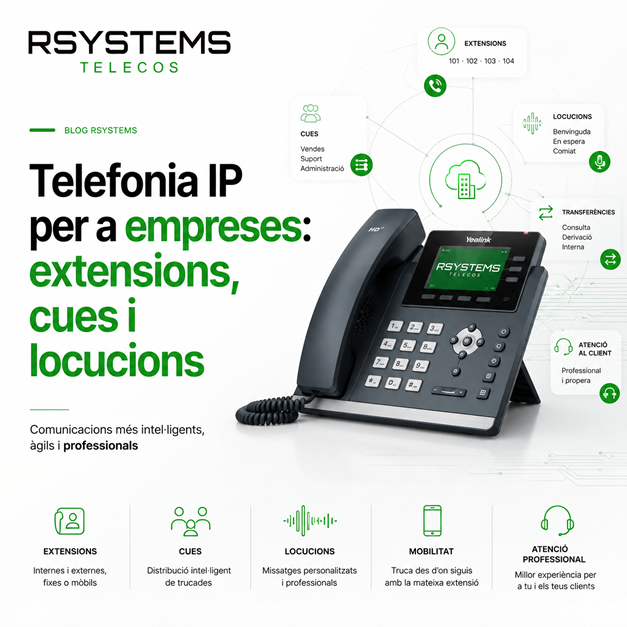
IP Telephony for Businesses: Extensions, Queues, Voice Prompts, and Mobility
Business telephony has changed. Today, companies no longer need to rely solely on traditional lines, fixed terminals, or physical PBXs that are difficult to expand. IP telephony for businesses allows companies to manage calls through the internet, with greater flexibility, more control, and many features designed for professional daily operations.
A business does not simply need to “have a phone”. It needs to handle calls effectively, route them correctly, avoid losing opportunities, provide a professional image, and allow employees to work from the office, from home, or remotely.
With a well-designed IP telephony solution, telephone communication stops being a technical challenge and becomes a more efficient business tool.
What Is IP Telephony for Businesses?
IP telephony is a system that allows companies to make and receive calls using an internet connection instead of relying exclusively on traditional telephone services. In business environments, it is usually combined with a SIP virtual PBX, internal extensions, call queues, voice prompts, schedules, and mobility options.
This technology allows companies to use physical IP phones, computer applications, softphones, or mobile apps. This provides much greater flexibility and makes it easier to adapt the phone system to the company’s actual way of working.
Why Should a Business Consider IP Telephony?
Many companies continue using older phone systems because “they still work”. However, working does not always mean working efficiently. If a company loses calls, cannot easily transfer them, does not have queues, cannot configure schedules, or depends too much on a single physical phone, it is likely using a limited solution.
IP telephony allows businesses to professionalize their telephone service without requiring large, rigid installations.
Greater flexibility
Extensions can be added, schedules modified, call forwarding configured, and call routing changed much more easily than with a traditional PBX.
Improved customer service
Calls can be distributed more effectively, directed to the correct department, and prevent customers from having to call repeatedly to get assistance.
Less dependence on a physical location
With IP telephony, teams can work from different locations while maintaining the same company phone structure.
More control
The company can have better visibility over incoming calls, missed calls, schedules, forwarding rules, and configurations for each department.
Telephone Extensions to Better Organize the Business
One of the basic features of business IP telephony is internal extensions. Each person, department, or area of the company can have its own extension.
This makes it easier to organize calls and prevents all incoming calls from reaching the same terminal. It also makes it easier to transfer calls to administration, sales, technical support, management, or any other department.
Department extensions
A company can create extensions for specific areas: administration, sales, support, warehouse, reception, or management. This helps provide faster and more organized responses.
User extensions
Each employee can have their own extension, useful whether they work from the office or from another location using a softphone or mobile application.
Extensions for offices or branches
If a company has more than one location, IP telephony allows them to be connected under the same structure, as if they were part of a single PBX.
Call Queues to Avoid Losing Customers
Call queues are highly useful when a company receives several calls at the same time. Instead of receiving a busy signal or losing the call, the system can keep customers waiting and distribute calls among different employees.
This feature is especially important for companies with customer service teams, technical support, sales departments, reception, or recurring call volumes.
Distribution among users
Calls can be distributed among different extensions according to availability, order, groups, or predefined configurations.
Waiting messages
While customers wait, voice prompts or informational messages can be played to improve the perception of the service.
Fewer missed calls
A properly configured queue helps reduce unanswered calls and prevents all requests from depending on a single person.
Voice Prompts and IVR Menus
Voice prompts provide a much more professional image for a company. They can be used to welcome callers, provide opening hours, offer options, or redirect calls to the correct department.
An IVR menu allows customers to choose the option they need: sales, administration, technical support, or any other department.
Welcome message
This is the message customers hear when they call the company. It can be a short and professional greeting.
After-hours message
When the company is closed, the PBX can provide opening hours and offer alternative options, such as leaving a message or using another communication channel.
Department menu
It allows calls to be directed more efficiently and prevents the same person from always acting as a filter.
Call Forwarding and Schedules: Adapting Telephony to the Business
A company does not always operate in the same way. There are working hours, holidays, vacations, shifts, on-call periods, or employees who only handle calls at certain times. IP telephony allows the PBX behavior to adapt to these scenarios.
Mobile call forwarding
When someone is away from the office, calls can be forwarded to a mobile phone or another extension.
Business hours
The PBX can operate one way during opening hours and another way outside business hours.
Holidays and special configurations
Specific messages or forwarding rules can be prepared for holidays, vacations, or temporary situations.
Mobility and Softphones
One of the major advantages of IP telephony for businesses is mobility. With a softphone or mobile application, users can make and receive business calls without being physically present in the office.
This is highly useful for sales teams, technicians, management, hybrid teams, or employees working from different locations.
Working outside the office
Users can continue using corporate telephony while away, maintaining a professional image with customers.
Remote work
IP telephony allows employees working from home to remain fully integrated into the company PBX.
Sales and technical teams
Teams that frequently move between locations can have greater flexibility without relying only on personal mobile phones.
IP Telephony and Professional Fiber
IP telephony requires a stable connection. Therefore, when a company wants to use a virtual PBX, extensions, queues, and mobility features, it is also necessary to review the fiber connection, router, internal network, and WiFi.
A poor connection can affect voice quality, cause interruptions, or create an inconsistent experience. That is why telephony and connectivity should be considered as a single solution.
If your company also wants to review its connection, you can visit our professional fiber for businesses page.
IP Telephony and Internal Networks
In addition to fiber connectivity, the internal network is also important. IP phones, computers, softphones, and other devices must operate on a stable infrastructure.
In some cases, it may be recommended to separate voice traffic from other network traffic, review switches, cabling, VLANs, or quality of service configurations.
A well-designed network helps prevent voice issues, interruptions, and difficult-to-diagnose incidents.
Common Mistakes in Business IP Telephony
IP telephony can work extremely well, but only if it is properly configured. Common mistakes include:
- Implementing IP telephony without reviewing connection quality.
- Failing to properly configure extensions and queues.
- Not preparing voice prompts or schedules.
- Using unsuitable routers or networks.
- Not providing basic user training.
- Not planning for mobility or remote work.
- Not having technical support for changes or incidents.
Which Businesses Benefit from IP Telephony?
IP telephony can suit many types of businesses, especially those that need to manage calls professionally.
Offices and service companies
Consultancies, accounting firms, real estate agencies, technical services, or administrative companies can greatly improve their telephone service.
Businesses with sales teams
IP telephony facilitates calling, follow-up, mobility, and integration with sales tools.
Companies with support or customer service teams
Queues, voice prompts, and extensions help distribute calls more effectively and reduce missed opportunities.
Companies with multiple locations
The virtual PBX allows different locations to be connected within a single telephone structure.
IP Telephony for Businesses with RSystems Telecos
At RSystems Telecos, we help businesses implement IP telephony solutions and SIP virtual PBXs adapted to their needs. We review the current setup, connectivity, terminals, extensions, schedules, queues, and mobility options.
The goal is for the company’s telephony system to operate clearly, flexibly, and professionally, with a configuration designed for the real day-to-day needs of the business.
You can find more information about this service on our SIP virtual PBXs for businesses page.
Would You Like to Modernize Your Company’s Telephony?
If your company needs extensions, queues, voice prompts, call forwarding, mobility, or a more flexible virtual PBX, we can help you review your current setup and propose an adapted solution.
Contact RSystems Telecos and tell us what you need.


